Development of SORMI (Summer Oyster Resilience and Mortality Index): A quantitative tool for improving field survival
Justification
Shellfish farming is one of the most sustainable protein production systems in the world (Hilborn et al., 2018) and contributes significantly to domestic aquaculture production, helping to offset the substantial U.S. seafood trade deficit (Kite-Powell et al., 2013). Washington State leads the nation in bivalve shellfish production and accounted for 30.5% of U.S. farmed shellfish sales in 2022, valued at $166.4 million, while Oregon sold $19.65 million, and California landed $31.5 million (Chinook Observer, 2024). Across coastal western region states, the principal species farmed is the Pacific oyster, accounting for 84.5% of total sales in 2018 (USDA NASS 2019).
In Washington, Oregon and California, “summer mortality” events present a major challenge for oyster farmers. Recurrent summer losses of Pacific oysters is a well-documented, global phenomenon that has been observed within and outside the oyster’s native range (Glude, 1974; Goulletquer et al., 1998; Imai et al., 1965) and specifically within the Pacific Northwest (Cheney et al., 2000; Perdue et al., 1981). Large-scale summer die-offs have been associated with abiotic and biotic factors that vary seasonally, including increasing seawater temperature (Perdue, 1983; Perdue et al., 1981). Additionally, seed and juvenile mortality has been observed when oysters experience acute temperature stress and herpesvirus infection simultaneously (Friedman et al., 2005; Renault, Cochennec, et al., 1994; Renault et al., 2000; Renault, Le Deuff, et al., 1994).
Broad, collaborative research is urgently needed to address and avoid catastrophic shellfish mortalities in Pacific oyster (Crassostrea (Magallana) gigas) aquaculture. Significant mortality of Pacific oysters have occurred during the summer months over the last sixty years and are becoming more frequent. These mortalities have a significant monetary impact on individual producers and constrain U.S. shellfish production. Evidence for this includes the impetus for NOAA to support the Sudden Unusual Mortality Syndrome (SUMS) In Oysters Workshop that strategically brought in experts from all coasts of the United States to identify solutions to address this substantial threat to the industry. The top three research priorities from this workshop are: 1) Mechanistic understanding of mortality events, including energy budgets, pathobiology, etc.; 2) Preparing oysters to withstand stress in all phases, for example through hardening or priming against future challenges; and 3) Breeding for increased, general resilience (VIMS, 2024). The proposed project directly addresses priorities 1 and 3, while indirectly providing a foundation to address priority 2.
Our proposed work directly addresses WRAC program priority 3. Aquaculture Opportunities through Genetics. Based on the only publicly funded genetic improvement program for shellfish in the western region, we provide a novel approach to a long-standing and increasingly problematic summer mass mortality that handicaps shellfish production in California, Oregon and Washington. Field survival is complex, and poorly defined when environmental and biotic factors cannot be easily quantified or controlled, as occurs in shellfish aquaculture. Growers have no control of temperatures, food availability, harmful algal species presence or pathogen exposure. Decades of research have attempted to isolate causative factors of Pacific oyster summer mortality, yet no smoking gun has been identified. Furthermore, Pacific oysters are produced in estuaries from San Diego to Kodiak Island which further complicates the isolation of individual factors on mortality due to the gigantic range in which oyster aquaculture occurs on the Pacific coast. In this study we approach mortality from a contrarian angle, asking not what specific factor kills oysters, but why do oysters survive? We hypothesize that the quantitative trait index (SORMI) we develop will predict market survival because animals that are better able to respond to stressors are less likely to die because of them. SORMI is a generalized stress resilience index that will be used by breeding programs to increase field survival and for farmers to assess the level of stress experienced by their oysters, which is exactly what industry is clamoring for. SORMI will advance genetic improvement in shellfish production and dovetail with ongoing efforts to increase survival against Ostreid Herpesvirus 1 (OsHV-1) and the implementation of genomic selection by the USDA ARS Pacific Oyster Genomic Selection
(POGS) project.
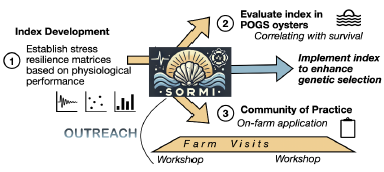
Figure 1. Overview of the proposed work. (1) To establish a stress resilience index in oysters using a combination of established and newly developed physiological traits. (2) This index will be evaluated by identifying traits that correlate with market survival in POGS oysters. In collaboration with a regional community of practice (3), the index will be used to monitor stress in commercial stocks and improve genetic breeding programs to select for high performance and resilience.
Objectives
Objective 1- Develop protocols necessary to implement a stress resiliency index to evaluate oyster performance.
Objective 2- Evaluate performance of the stress resilience index in POGS oysters grown under commercial conditions to quantify the correlation between stress resilience and survival to market.
Objective 3- Establish a regional community of practice with commercial oyster operations using the stress resilience index.
Project Summary
- 4 years
- 09/01/2025
- $797,273
- Role: PI
- Steven RobertsRole: PI
- Neil ThompsonRole: PI
- Role: PI
- Kevin Marquez JohnsonRole: Outreach coordinator
- Role: Industry advisor
- Ken OverturfRole: Project monitor